Naolima® Journal Montessori Bookshelf: Encouraging Independent Reading
13. October 2025
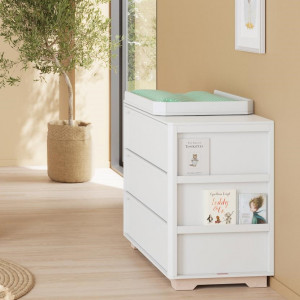
If you want to raise your child to be an independent thinker and a curious learner, it begins with the way they access books. A Montessori bookshelf supports exactly this principle: it displays books openly and at child height so your child can choose what they want to read or look at. This naturally promotes a love for books and reading instead of forcing it. The result is an environment that strengthens initiative, concentration, and joy in learning—perfectly in line with Montessori education.
Although the Montessori bookshelf does not come directly from Dr. Maria Montessori herself, it reflects her educational principles perfectly. Unlike traditional shelves where only the spines are visible, this type of shelf displays book covers facing forward—and that instantly sparks children’s curiosity and attention. They can see at a glance which books are available, rediscover their favorite stories, and feel encouraged to browse and read. At the same time, they learn to keep things tidy, because putting books back—in contrast to traditional shelves where books must be squeezed into a small space—is simple and intuitive, fully supporting child-led independence.
What Is a Montessori Bookshelf – and Why Is It So Valuable for Your Child?
At the core of the Montessori principle is the promotion of children’s natural curiosity and desire to explore. Montessori bookshelves are therefore designed so that children can easily remove and replace books and access them at any time. It is especially important that books are placed at child height and displayed with the covers facing forward so children can immediately see what is in the shelf.
A Montessori bookshelf is characterized by two key features:
Accessibility
Your child can easily reach every book, fostering independence.
Visibility
Books are displayed with their covers facing forward, allowing your child to intuitively choose what they want to read.
This simple yet thoughtful design offers many benefits:
- Decision-making: Your child learns to choose on their own and take responsibility for their decisions.
- Order and structure: Books can be placed in and out effortlessly—strengthening a sense of order.
- Sensory stimulation: Colors and images on covers spark interest and encourage reading.
- Focus instead of overstimulation: A clear, manageable selection creates calm and concentration.
Following the motto “less is more,” it is recommended to offer only 5 to 10 books at a time and rotate the selection regularly. Children love repetition—familiar stories give them comfort and joy.
With a Montessori bookshelf, you’re giving your child more than a piece of furniture—you’re creating an inspiring environment where independence, organization, and a love for books develop naturally.
How to Choose the Best Montessori Bookshelf
The most important factor is accessibility: the shelf should be low enough for your child to reach all compartments easily—no need for wobbling stools or dangerous climbing.
Visibility is also essential. A good Montessori bookshelf displays the covers of the books so your child immediately sees the available options.
Consider whether you want to organize the books by color or theme. This makes it easier to find favorites and strengthens a sense of order and independence.
Adequate space is crucial too. An overcrowded shelf quickly becomes confusing. Each book should have its own spot so tidying up becomes easy and enjoyable.
Also pay attention to the material: a sturdy shelf made of birch plywood or MDF is durable, robust, and safe for children.
Checklist for the perfect Montessori bookshelf:
- Low and accessible for small children
- Covers facing forward
- Sorting by color or theme
- Enough space—don’t overfill
- Robust, safe material

With these tips, you’ll find the ideal bookshelf for your little bookworm!
How to Set Up a Montessori Bookshelf in a Child’s Room
A Montessori bookshelf can be arranged in a way that truly invites children to read. Here are some proven tips:
Location & Lighting
Choose a well-lit place that your child can easily reach. It should stand freely, not squeezed between other furniture—so access remains simple and safe.
Selection & Organization
Clarity instead of clutter: Display only a limited selection of books and rotate them regularly. This keeps interest alive and prevents overwhelm. A small selection is often more appealing and creates a sense of calm.
Content & Variety
Choose books appropriate to your child’s age and interests. A good mix of non-fiction, storybooks, and picture books promotes both imagination and knowledge.
Theme weeks—like “Garden Animals,” “Farm Life,” or “Around the World”—keep the bookshelf exciting.
Beautiful illustrations and child-friendly texts make books especially inviting. A mix of read-aloud and early-reader books supports your child through different developmental phases and promotes language and independence. Books that convey knowledge in playful ways are especially valuable—they awaken curiosity and make learning a natural part of daily life.
Cleanliness & Care
Keep the shelf clean so it remains inviting. A well-maintained bookshelf shows your child that books are valuable and deserve care.
Design & Accessibility
The shelf should be simple, stable, and designed at child height. When book covers face forward, children can choose independently—fully in line with Montessori philosophy.
Conclusion
When designing a child-friendly environment, Montessori bookshelves play a central role. They give your child the opportunity to practice independence and actively explore their surroundings. Through open and inviting book presentation, the room becomes a place that promotes curiosity, concentration, and joy in learning. At the same time, your child learns to take responsibility for their belongings and to view order as something positive. Thus, the bookshelf becomes more than a functional piece of furniture—it becomes an important cornerstone of a mindful and loving learning environment.
What is a Montessori bookshelf?
A Montessori bookshelf is a specially designed, child-friendly shelf that displays book covers facing forward. Thanks to its low height, children can access their books independently and freely choose what they want to read.
What makes a Montessori bookshelf special?
Its child-friendly height, the front-facing book covers, and the clear, uncluttered layout. These features promote independence, curiosity, and a love of reading.
How many books should be displayed?
It is recommended to display only a limited selection (around 5–10 books). This prevents overwhelm and helps children focus on the books offered.
What age is a Montessori bookshelf suitable for?
Montessori bookshelves are suitable for children from crawling age up to early school age, roughly between 1 and 7 years old.
What should you look for when buying a Montessori bookshelf?
Look for stable, tip-resistant shelves at child height that display books with covers facing forward. This makes selection easier and ensures everyday safety.
Where can I buy a Montessori bookshelf from Naolima?
We currently do not have a Montessori bookshelf in our assortment. However, we do offer several other great products available through our selected retail partners in Germany, Austria, and the Netherlands—such as in Frankfurt, Düsseldorf, Munich, Berlin, Vienna, or Münster.